
AI hiring in Europe: 771 open AI roles, as Celonis adds 16 in a week (16 Nov 2026)
Updated: 2 days ago
This is our weekly report on AI engineering hiring in Europe. On 16 November 2026 we read the public job feeds of 431 tech companies that hire in Europe, from AI startups and scale-ups to the European offices of US AI labs, and analysed every open role.
The short version: AI hiring held steady this week, down 1.3% like-for-like, and it remains senior, focused on production LLM systems and almost entirely full-time. Here is what the data shows.
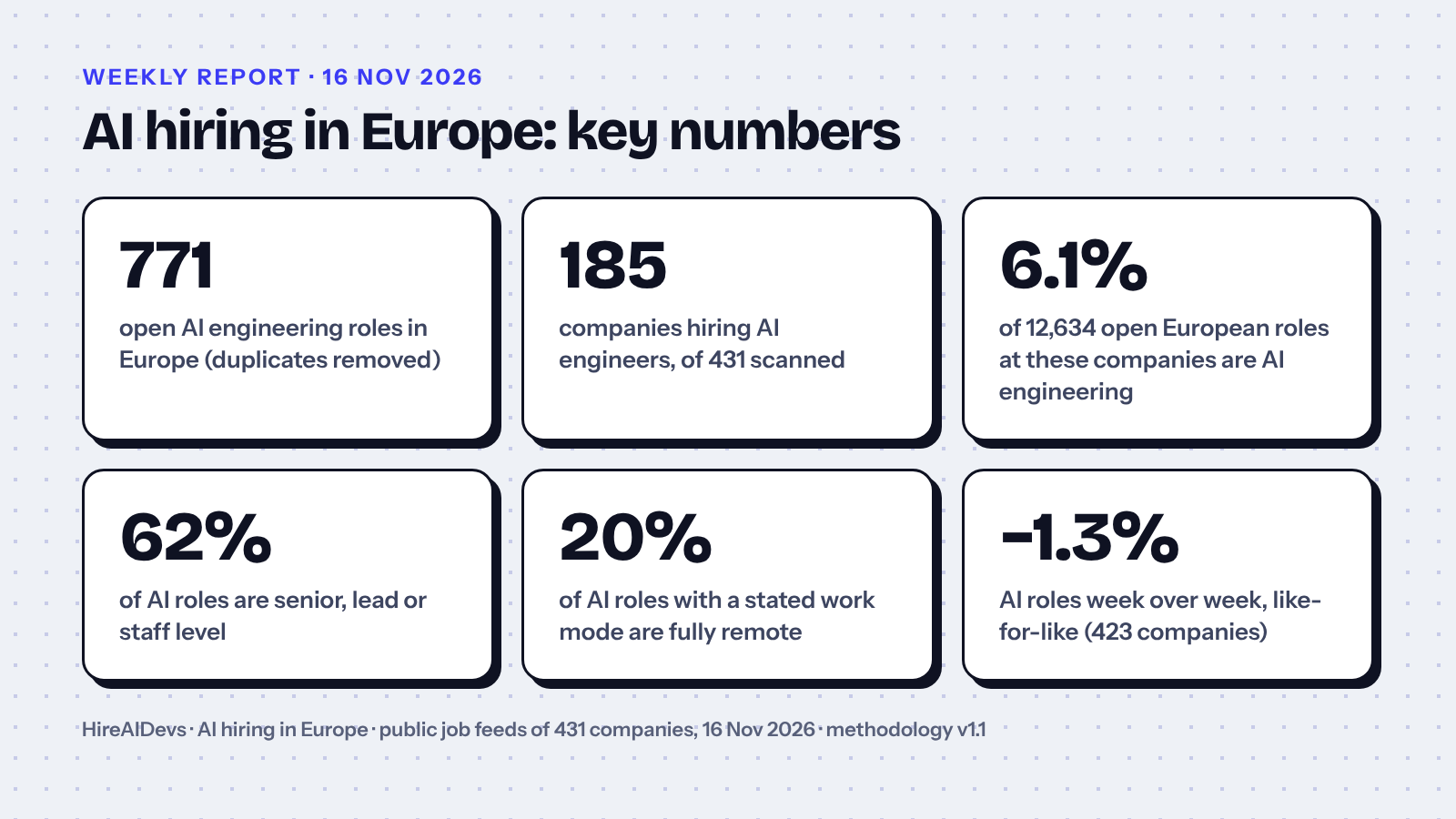
Key numbers this week
771 open AI engineering roles in Europe, at 185 of the 431 companies we scanned (identical adverts counted once).
Week over week, like-for-like: across the 423 companies whose feeds loaded in both weeks, AI roles went from 781 to 771 (-10, -1.3%). The number of companies hiring AI engineers was unchanged at 185, and all open European roles fell from 12,755 to 12,634.
Biggest increases: Celonis (+16 AI roles), then Experian and Farfetch (+3 each), PhysicsX and Datadog (+2 each). The largest decreases were at Databricks (-6), Sword Health and Monzo (-5 each).
AI roles are 6.1% of the 12,634 open European roles at these companies. At AI-native companies the share is 11.4%; at large corporates it is 3.5%.
62% of AI roles are senior, lead, staff or principal level. Only 3% are junior or internships. Across all roles at the same companies, 47% are senior or above.
Of the AI roles that state a work mode, 65% are hybrid, 20% fully remote and 15% on-site.
Only 4 of 771 roles (0.5%) are advertised as contract, freelance or fixed-term.
234 AI roles were published in the last 30 days, and 66 in the last 7 days.
Hiring is spread widely: the three companies with the most open AI roles account for 12% of the total.
Where the AI roles are
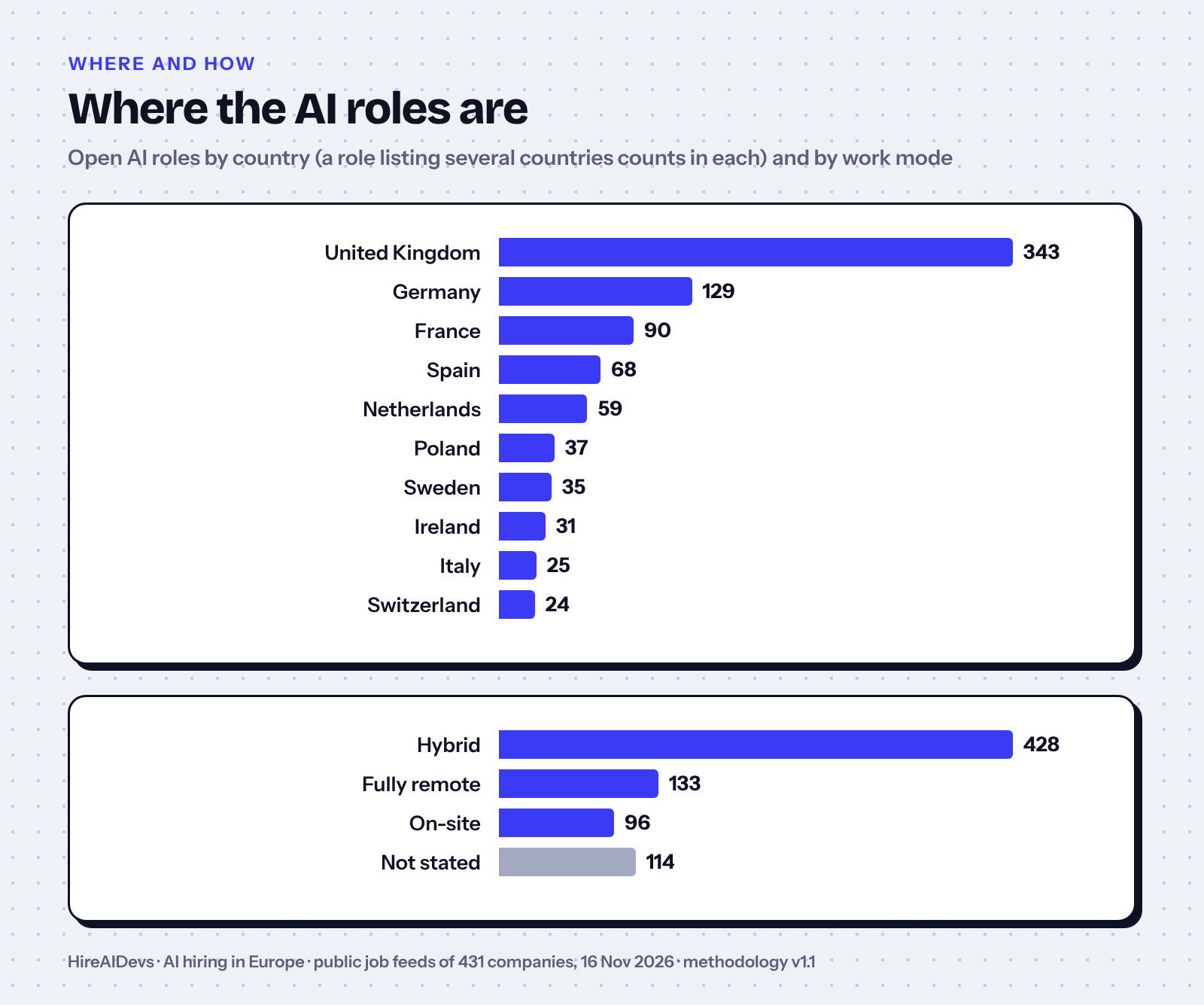
The UK leads with 343 roles, and London alone accounts for 279. Germany follows with 129 (Berlin 73, Munich 45), then France with 90 (Paris 78), Spain with 68 and the Netherlands with 59 (Amsterdam 45). A role listing several countries counts in each of them.
The AI share of hiring differs a lot by country. In the UK, 10.8% of open roles at these companies are AI roles, and in Switzerland 9.9%. In Germany it is only 4.5%. Poland stands out with 8.0% (37 roles).
There are 133 fully remote AI roles, and European scale-ups offer most of them (82). Startups and AI-native companies are the most office-centric: a third of their AI roles (31 of 93) are on-site.
What companies are hiring for
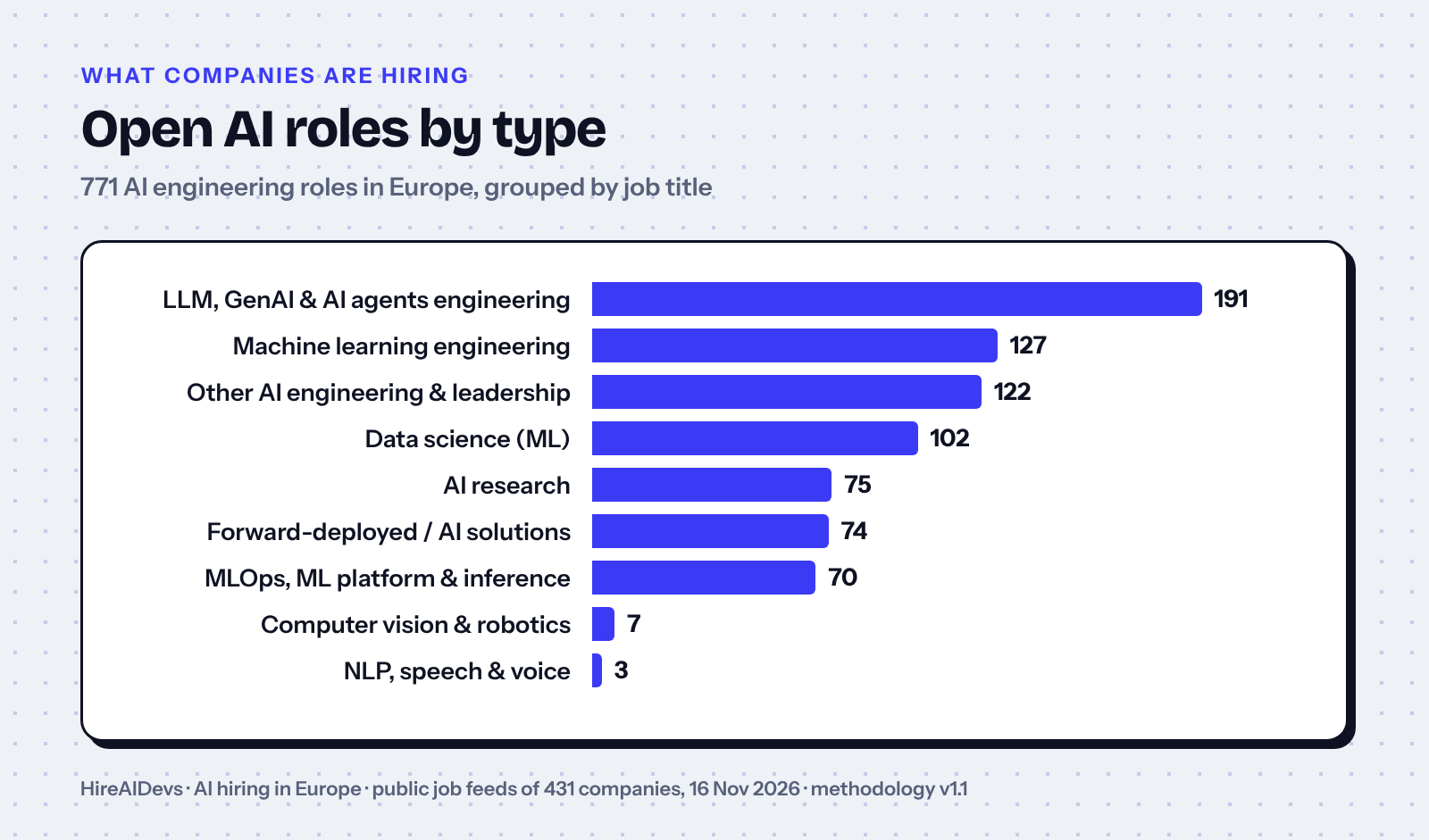
LLM, GenAI and AI agents engineering is the largest group with 191 roles, about a quarter of the total. Titles include AI engineer, applied AI engineer, agent engineer and GenAI engineer.
Machine learning engineering (127) and ML data science (102) remain large categories.
Forward-deployed and AI solutions engineers account for 74 roles, used to put LLM agents into customers' production systems.
AI research has 75 roles, and MLOps, ML platform and inference has 70.
35 roles have "architect" in the title, for example AI architect or agent architect.
The companies with the most open AI roles in Europe this week are Celonis (34), OpenAI (30), Nebius (29), Preply (26), Graphcore (23), Faculty (21), Prima and Anthropic (20 each), and Doctolib and Wayve (16 each). Celonis tops the list after adding 16 AI roles in a week.
Skills in demand
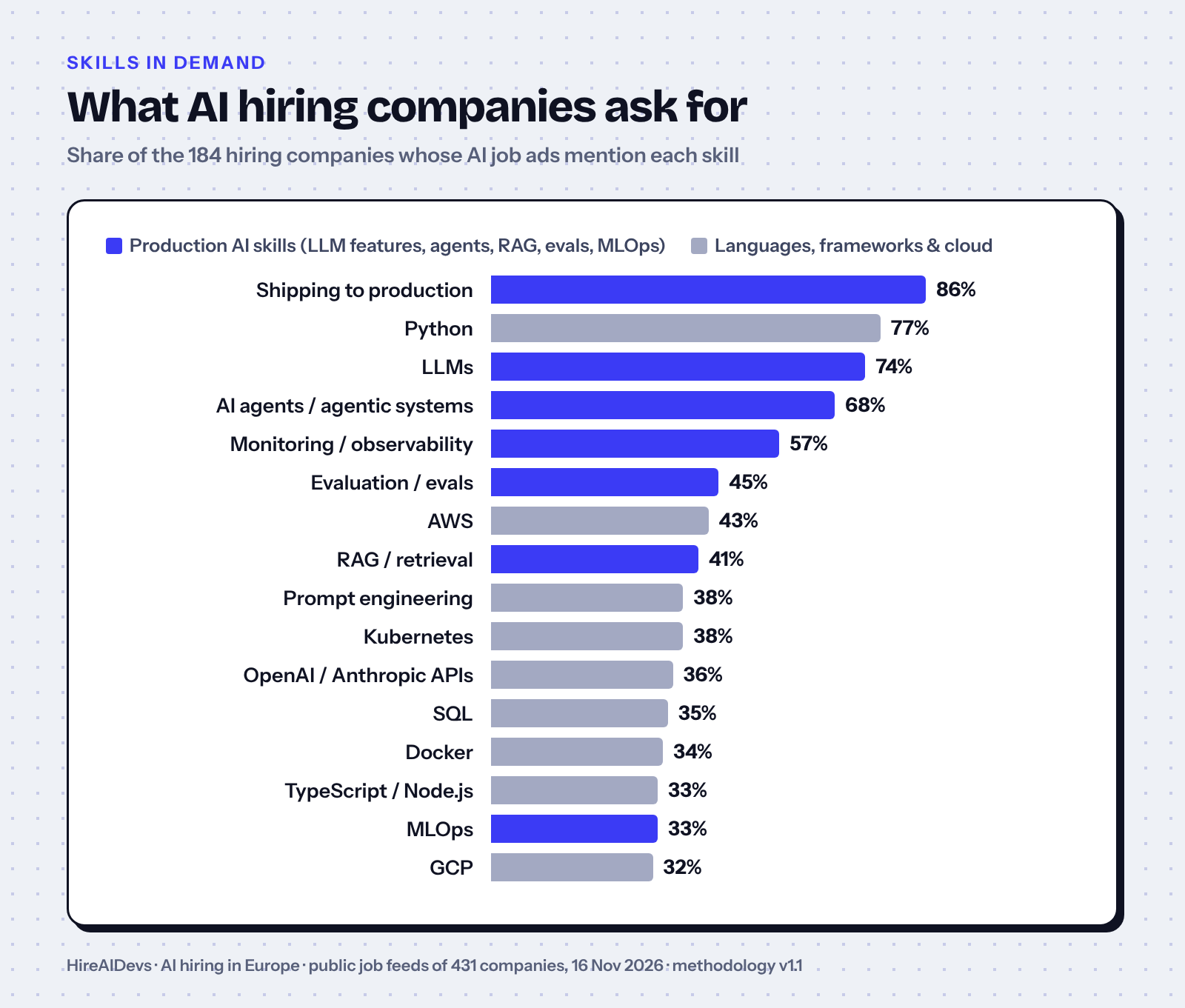
We counted skills both per job ad and per company. The company view is harder to distort: one employer posting many similar ads cannot move it. Of the 184 companies with AI job descriptions:
86% ask for experience shipping AI to production.
74% mention LLMs and 68% mention AI agents or agentic systems (at the ad level, 50% of individual AI ads mention agents).
Monitoring and observability: 57%. Evaluation and evals: 45%. RAG and retrieval: 41%. Guardrails and safety: 30%.
MLOps: 33%. Fine-tuning: 24%.
Python: 77%. AWS: 43%. Kubernetes: 38%. PyTorch: 30%.
The takeaway: employers care less about specific tools than about the ability to build and run LLM systems reliably. Production LLM features, AI agents, retrieval, evaluation and monitoring are the skills we test for when we vet our fractional AI engineers.
Salaries: what the job ads say
87 of the 771 AI roles, at 36 companies, publish a usable salary range in a European currency. We show the median advertised lower and upper bound for each group, converted to euros at ECB reference rates. Groups with fewer than 10 salaries, fewer than 3 companies, or one company providing more than half of the salaries are not shown.
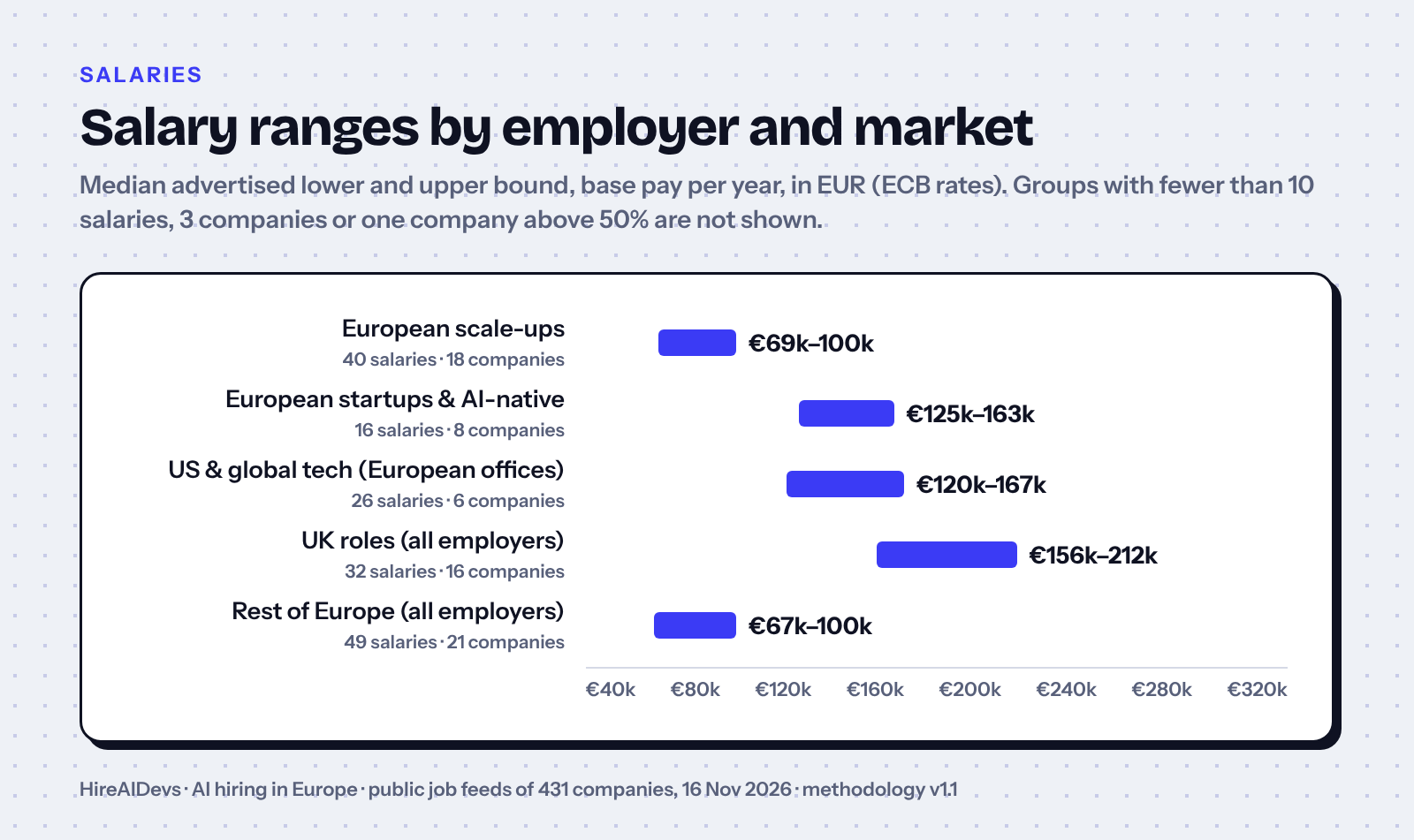
European scale-ups: €69k–100k (40 salaries).
European startups and AI-native companies: €125k–163k (16 salaries).
European offices of US and global tech companies: €120k–167k (26 salaries).
UK roles: €156k–212k, compared with €67k–100k for roles in the rest of Europe.
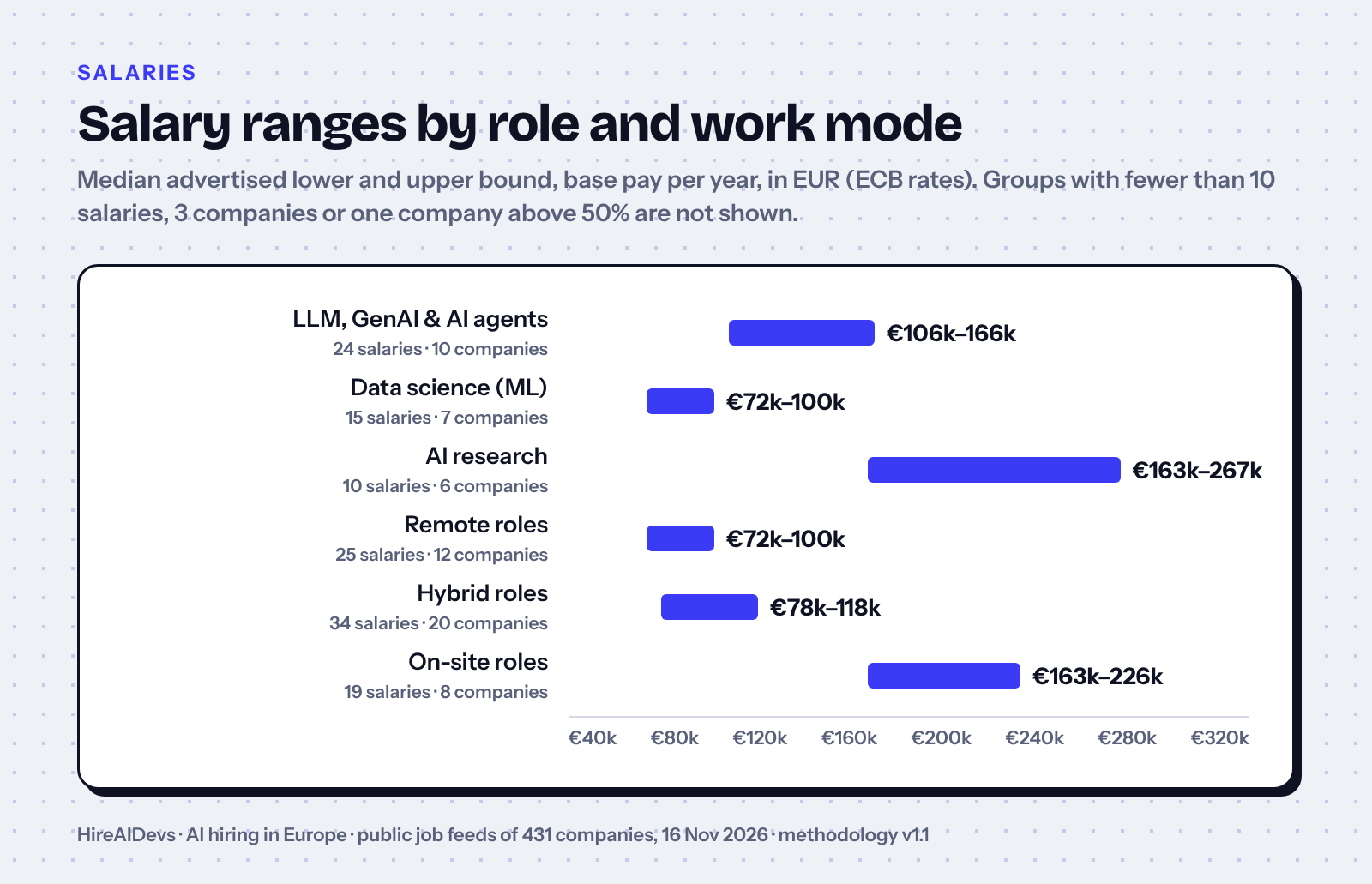
LLM, GenAI and AI agents roles: €106k–166k, well above ML data science (€72k–100k).
AI research: €163k–267k, from 10 salaries at 6 companies.
By work mode: remote €72k–100k, hybrid €78k–118k, on-site €163k–226k. The on-site premium mostly reflects London-based AI-native and US AI companies, which rarely hire remotely.
Not shown this week: machine learning engineering (one company provides more than half of the salaries), corporates (5 salaries), forward-deployed and AI solutions (8), MLOps (9), other AI engineering and leadership (8), and individual countries other than the UK (each below the minimum sample).
What this means for startups hiring AI engineers
Expect to compete for senior engineers. 62% of open AI roles are senior or above, and London offices of US AI companies advertise well above €150k. A full-time senior search can take months.
Screen for production skills, not frameworks. 86% of hiring companies ask for production experience. Ask candidates about LLM features they shipped, RAG, AI agents, evaluation and monitoring in production.
Flexible models are almost absent from the market. Only 0.5% of roles are contracts. A fractional AI engineer working 1–3 days a week can start in days, ship your first production AI features and help you define the full-time role.
Search across Europe. Advertised salaries in the rest of Europe (€67k–100k) are well below UK levels (€156k–212k), and Europe-wide remote hiring widens both your talent pool and your budget options. For your first AI hire, see our guide to founding AI engineers.
Need senior AI capacity now? Book a 15-min call and meet vetted, Europe-based AI engineers.
Related guides
Methodology (version 1.1)
What this measures. Advertised AI engineering vacancies at a selected set of tech companies hiring in Europe: mostly startups, scale-ups and European offices of global tech companies. It is a snapshot of the companies covered, not of the whole European AI job market. HireAIDevs operates an AI engineering talent network; the data is collected and classified by fixed rules set in advance, described below.
Coverage. On 16 November 2026 we read the public job feeds (Ashby, Greenhouse, Lever, Workable, Recruitee, Personio and SmartRecruiters) of 431 companies. 423 feeds loaded, containing 26,536 advertised roles worldwide across all job categories. Of these, 12,634 were classified as European after removing 163 identical adverts. Feeds that did not load this week: Learnworlds, Hugging Face, Clarity AI, Shield AI, Manual, Epignosis, Kambi, Giskard. Week-over-week changes compare only the 423 companies whose feeds loaded in both weeks.
Europe. The EU/EEA, the UK, Switzerland, Ukraine, the Western Balkans and Moldova. Remote roles count when the advert's location names Europe, EMEA or a country in scope. A vacancy listing several countries counts once in the totals and once per country, so country figures can add up to more than the total. Identical adverts (same company, title and location) are counted once.
AI engineering roles. Identified from job titles using a fixed keyword list; non-engineering functions such as sales, recruiting, legal and marketing are excluded. This may miss AI-heavy roles with generic titles and include roles with limited AI focus.
Characteristics. Seniority comes from job titles; roles without a clear level are grouped as "mid or unspecified". Work mode and employment type come from job-board fields or advert text. Skills are counted when mentioned in a job description, which does not always mean the skill is required. Employer categories are HireAIDevs' approximate classification. "New" roles use the publication date reported by the job board.
Salaries. Published base-pay ranges only, annualised and converted to euros at the latest ECB reference rates available on the scan date (13 November 2026). Excluded: ranges in USD, duplicates and values outside €15k–€600k a year (or €150–€3,000 a day); this week 12 duplicates and 6 implausible values were removed. For each group we show the median lower bound, the median upper bound and the number of salaries. A group is shown only with at least 10 salaries from at least 3 companies, with no company contributing more than half. These are advertised ranges, not salaries actually paid.
Funding. Funding rounds come from cited third-party sources, not from job feeds. This week we did not include a funding section.
Limitations. Results depend on the selected companies and on feed availability; companies without public feeds, including many large corporates, are excluded. Vacancies are not hires. Title-based classification, incomplete adverts and undetected duplicates can affect results. All figures are approximate.
Corrections. Spot an error? Let us know through hireaidevs.io. Changes to this methodology will be listed here with their dates. Version 1.1, 5 November 2026: identical adverts removed from counts, minimum sample rules for salaries, ECB exchange rates and company-level skill figures added.
The next update will be published on Monday 23 November 2026.

Comments