
What is a forward deployed engineer, and how to hire one for your AI startup
Many AI products work in the demo and stall at the customer. The model is fine. What's missing is someone who can sit with the customer, understand their messy data and workflow, and get the AI working inside their systems. That person is a forward deployed engineer, or FDE.
FDE is one of the fastest-growing engineering roles of 2026. This guide explains what an FDE does, how the role differs from a software or solutions engineer, when a startup needs one, what the first 12 weeks should look like, and how to hire one without wasting months.
What is a forward deployed engineer?
A forward deployed engineer is a software engineer who works directly with customers to deploy and adapt a product inside their environment. Instead of building the core product back at the office, an FDE:
learns the customer's real problem and workflow, often on site;
writes production code in the customer's environment: integrations, data pipelines, AI agents and custom workflows;
gets the solution live in weeks, not quarters;
brings what they learn back to the product team, so the next customer is easier.
The role comes from Palantir, which called its FDEs "Deltas" and, according to LeadDev, had more of them than regular software engineers until 2016. AI companies including OpenAI, Anthropic, Microsoft and Google now hire for it.
Why FDE demand is exploding
According to Lightcast data reported by Fortune, FDE job postings from January to August 2026 were up more than 1,000% compared with the same period in 2025, while tech postings overall grew 13%. The median advertised FDE salary was over $188,000, compared with about $145,000 for traditional software engineers.
The reason is simple. Many companies buy AI tools but struggle to get them into production. MIT's NANDA research found that only about 5% of generative AI pilots delivered fast revenue gains, as Fortune reported, and blamed poor integration into real workflows rather than the models themselves. Paraform cites S&P Global data showing the share of companies abandoning most of their AI initiatives before production rose from 17% to 42% in a year.
FDEs close that gap between "it works in the demo" and "it works for this customer." The model is usually the easy part. The hard part is permissions, data plumbing, evaluations and working closely with the people who will use the system every day.
FDE vs software engineer, solutions engineer and contractor
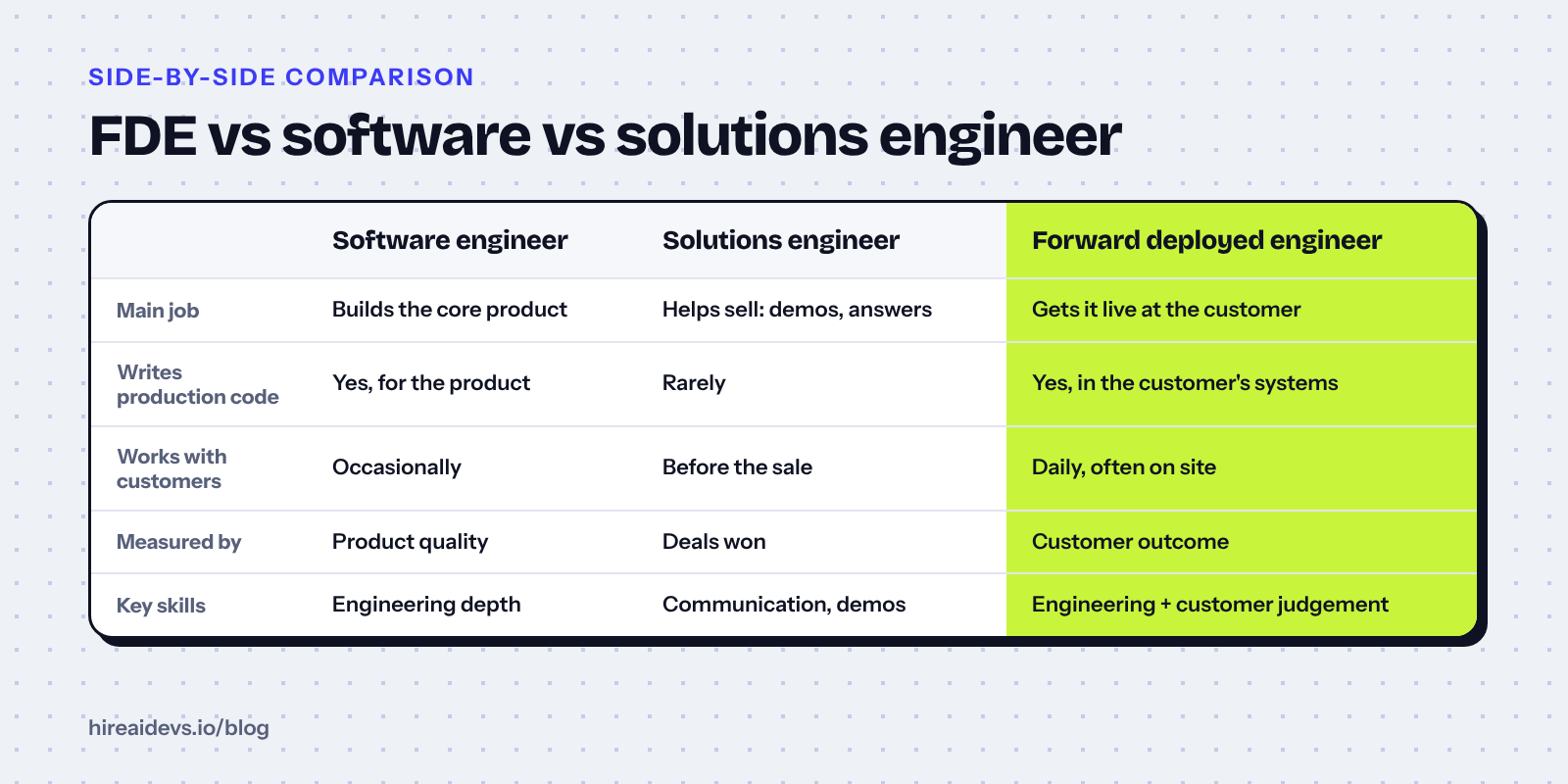
Software engineer: builds and maintains your core product. Measured by product quality and delivery.
Solutions or sales engineer: helps sell the product with demos, technical answers and proofs of concept. Usually doesn't ship production code for the customer.
Contractor (staff augmentation): adds capacity to a backlog you already direct. You own the plan; they deliver the tasks you give them.
Forward deployed engineer: owns the outcome at the customer. Writes production code, adapts the product to real data and stays until it works. Right when you know the problem but not the solution.
Be careful with the title. LeadDev's experts warn it's often given to anyone who is "customer-facing and a little bit technical." A real FDE is an engineer first.
When does a startup need an FDE?
You probably need one if:
every new customer needs custom integrations or data work before your AI is useful;
pilots start well but stall before going live;
your core engineers keep getting pulled into customer projects;
you sell to enterprises, government or regulated industries where the customer's environment is complex.
If your product is self-serve and customers onboard without help, you likely don't need an FDE yet.
What to look for when hiring an FDE
Production AI experience. They've deployed LLM features, RAG or AI agents with real users, real data and real constraints.
Integration skills. APIs, data pipelines, cloud infrastructure and working in unfamiliar codebases.
Customer judgement. They understand the client's workflow before proposing changes, and can push back with evidence.
Clear communication. They can explain technical tradeoffs to a CTO and to a non-technical operations lead.
Comfort with ambiguity. Customer problems rarely come with a spec.
Domain knowledge. Experience in your customers' industry (defense, healthcare, logistics, finance) is a strong advantage.
How to interview an FDE
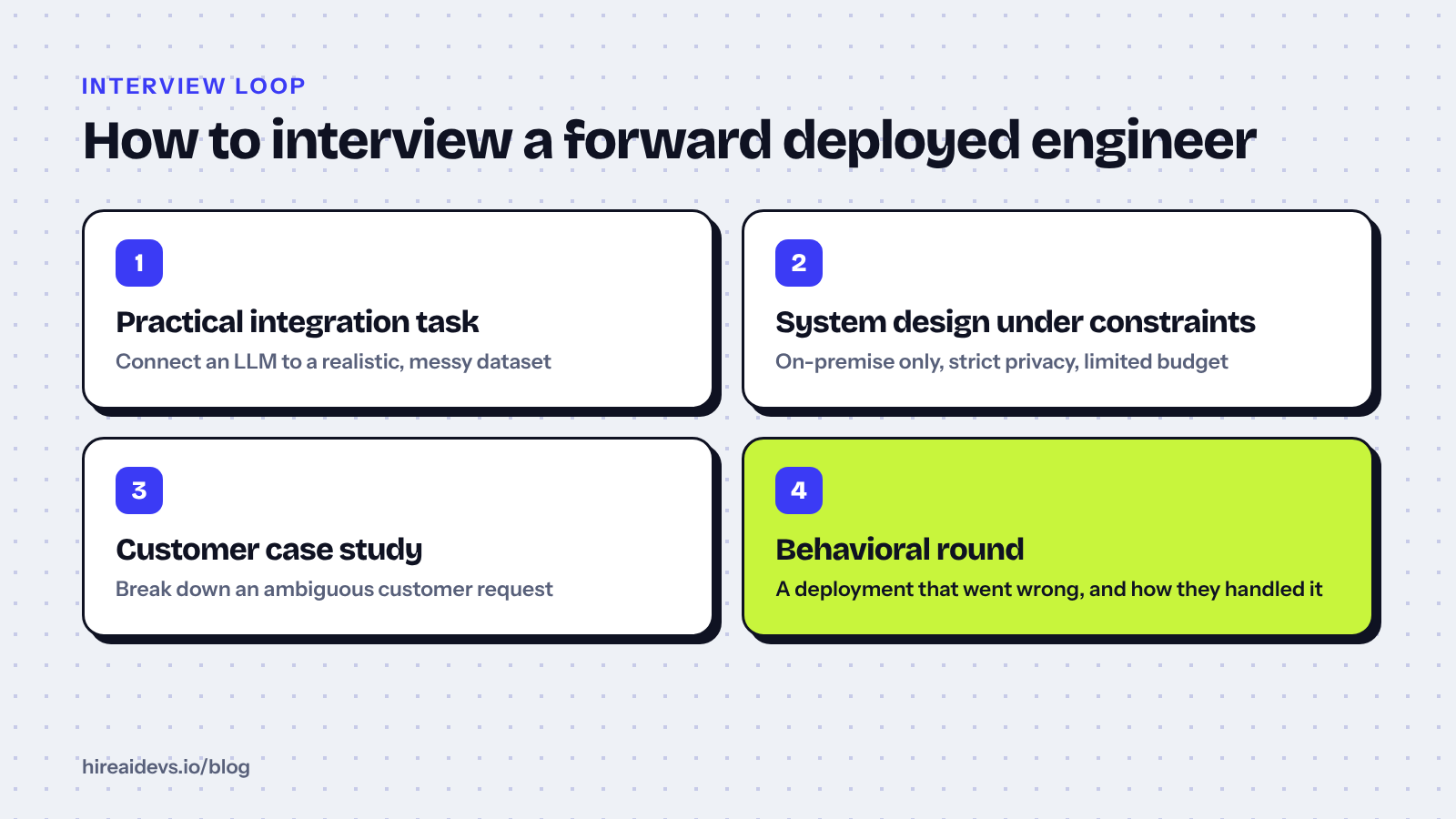
Standard algorithm interviews miss what matters. A better loop:
Practical integration task. Connect two systems or an LLM to a realistic, messy dataset.
System design under constraints. For example: on-premise only, strict data privacy, limited budget.
Customer case study. Give an ambiguous customer request and ask how they'd break it down.
Behavioral round. Ask about a deployment that went wrong and how they handled the customer.
A good sign: the candidate describes past work by customer outcome, such as time saved or errors reduced. A warning sign: they only want to talk about the code.
What the first 12 weeks look like
A good FDE engagement moves from discovery to a system your own team can run:
Weeks 1–2: discovery. Sit with the users, map the workflow and data sources, agree on one measurable outcome.
Weeks 3–6: first slice in production. Ship one narrow use case on real data, with an evaluation set and a human in the loop.
Weeks 7–10: harden and expand. Improve accuracy, cost and monitoring, then add the next use cases.
Weeks 11–12: handover. Documentation, runbooks and training, so your team can operate and improve it without the FDE.
If nothing is in production by week six, stop and ask why. Every month a system isn't live is value you don't get.
Why time zone overlap matters
FDE work is live work: workshops with users, debugging sessions with your IT team, same-day fixes. Harvard Business School research by Choudhury, Chauvin and Pan Fang found that one extra hour of time difference cut live calls and video meetings between colleagues by 11%, while email stayed the same. For a European company, an FDE in a European time zone can join the same meetings and fix things the same day.
Full-time, fractional or project-based?
For a startup, the first FDE doesn't always need to be a full-time hire:
Full-time FDE: right when you have a steady flow of customer deployments, or need someone on site. Paraform estimates a full search takes 8–12 weeks.
Fractional FDE: a senior engineer 2–3 days a week, to get your first customers live and learn what the role really needs.
Project-based: one engineer to deliver a specific customer deployment, then hand over.
Many startups start fractional, then hire full-time once they know what the role involves. See our guides to fractional AI engineers and founding AI engineers, and our AI engineer levels guide.
FAQ
Is a forward deployed engineer the same as a solutions engineer?
No. A solutions engineer mainly supports sales with demos and technical answers. An FDE writes production code and is accountable for the system working at the customer.
Does every AI project need an FDE?
No. If a licensed tool solves the problem, or the task is clearly specified, a regular engineer or contractor may be enough. FDEs pay off when the problem is clear but the AI solution, the data and the integration are not.
How long does it take to hire a full-time FDE?
Usually two to three months for a full search. A fractional FDE can often start within weeks.
Can an FDE work remotely?
Partly. Some work needs to happen on site, especially early discovery and in regulated environments. Much of the rest can be done remotely, as long as working hours overlap with your team.
Related guides
Need a forward deployed engineer?
HireAIDevs connects startups with vetted, Europe-based AI engineers who have shipped AI to production, including engineers with forward-deployed, solutions and customer-facing experience. Tell us about your customers and deployments, and we'll introduce 2–3 engineers who fit: fractional, remote or full-time.

Comments