
How to hire a senior applied AI engineer who has shipped LLMs to production
Plenty of engineers can build an impressive AI demo in a weekend. Far fewer have kept an LLM feature running for real users: measuring quality, controlling cost, handling failures and improving it month after month. That's the job of a senior applied AI engineer, and it's the hire that decides whether your AI product works.
This guide explains what an applied AI engineer does, how the role differs from a machine learning engineer, which skills companies actually ask for, and how to interview for production experience.
What is an applied AI engineer?
An applied AI engineer builds products and features on top of foundation models such as GPT, Claude, Gemini or open-source LLMs. They usually don't train models from scratch. They design, evaluate and run the system around the model:
retrieval (RAG) over your company's data;
AI agents and tool use;
prompts and context: what the model sees, in what order;
evaluation: test sets and metrics that show whether the AI is working;
cost, latency and reliability in production.
A study of more than 1,000 "AI Engineer" job ads in Berlin, Amsterdam, London, Los Angeles and New York, by Alexey Grigorev and Valeriia Kuka, found that about 70% of the roles work directly on LLM and generative AI systems, and 95.6% are production-focused. Fewer than 2% were traditional machine learning roles.
Applied AI engineer vs machine learning engineer
These are different jobs, and hiring one when you need the other is a common mistake.
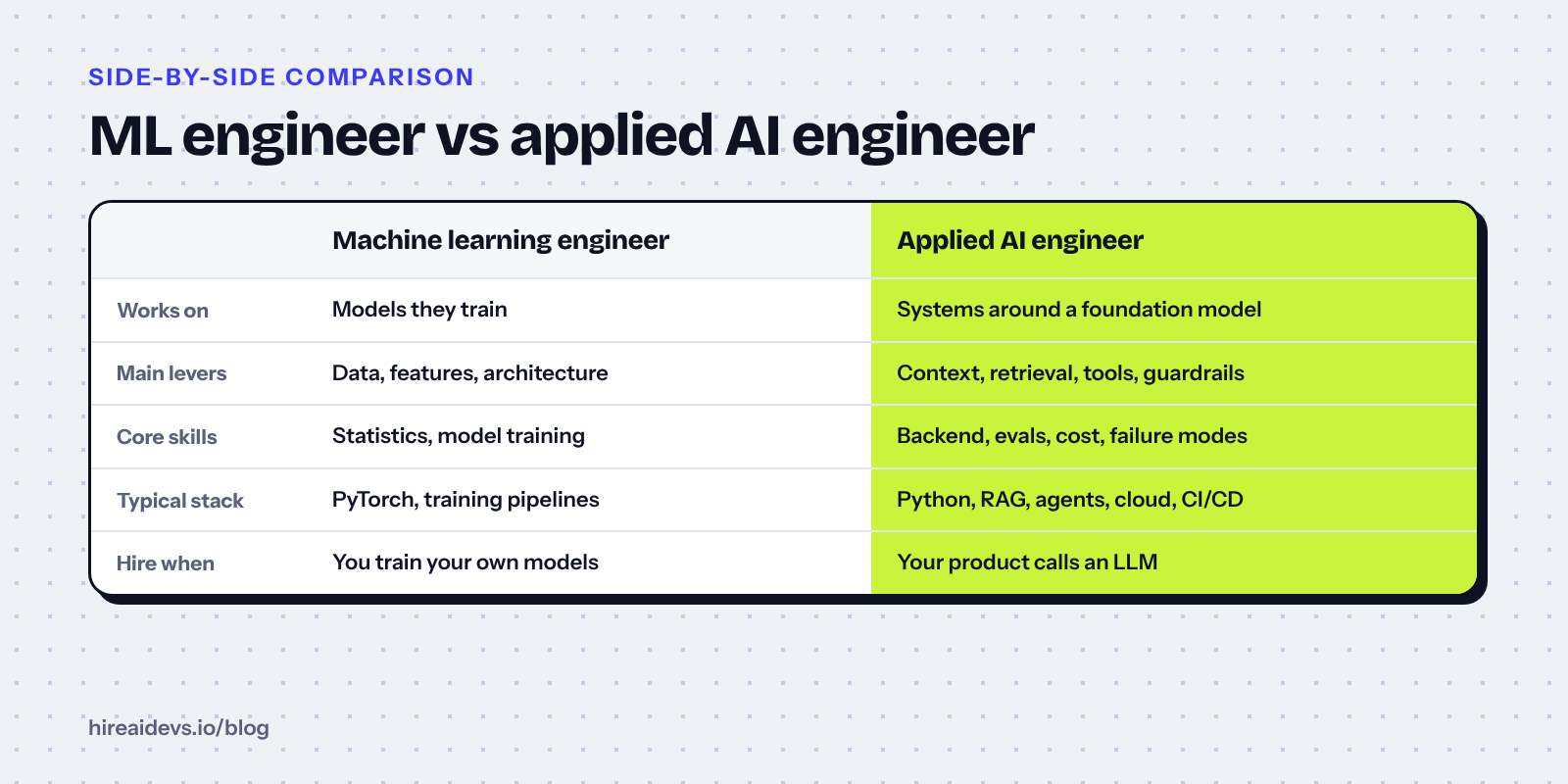
Machine learning engineer: trains and improves their own models. Works with data, features, architecture and model training.
Applied AI engineer: builds reliable systems around a model they usually access through an API. Works with context, retrieval, tools, orchestration and guardrails.
As Tian Pan puts it, moving an ML team onto LLM projects often fails because the skills overlap less than people expect. If your product calls an LLM rather than training one, you most likely need an applied AI engineer.
Skills that companies ask for
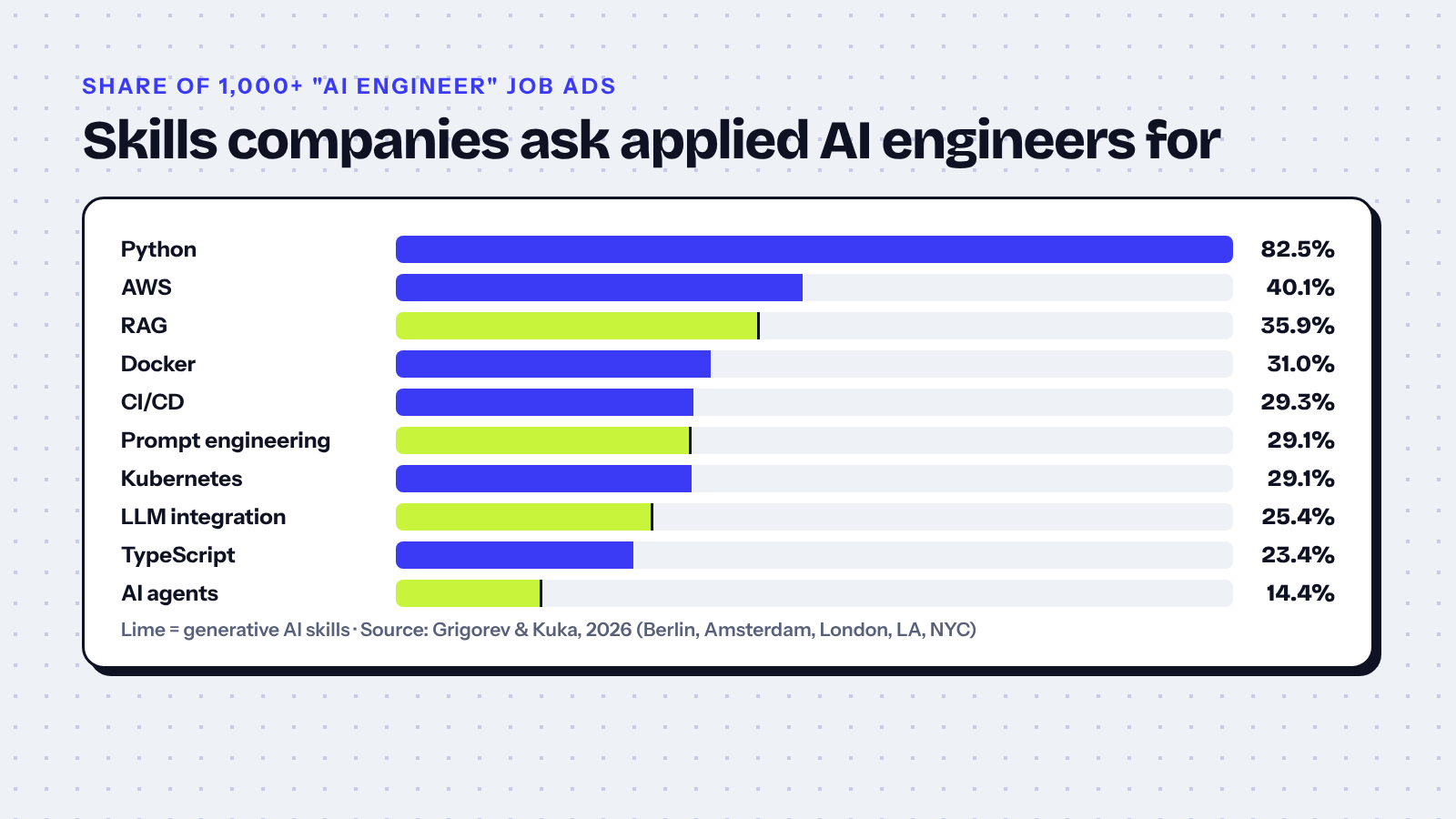
In the same job-ad study, the most requested skills and tools were:
Python in 82.5% of postings, and TypeScript in 23.4%;
AWS in 40.1%, Docker in 31.0%, CI/CD in 29.3% and Kubernetes in 29.1%;
RAG in 35.9%, prompt engineering in 29.1%, LLM integration in 25.4% and agents in 14.4%.
Notice the pattern: most of this is software engineering and infrastructure, not research. A strong applied AI engineer is a strong backend engineer who also knows how LLMs fail.
What "senior" really means
Tools and frameworks change every few months. What separates a senior applied AI engineer is judgement built from running AI in production:
Evaluation discipline. They define metrics and build test sets before shipping, and catch regressions when prompts or models change.
Cost control. They can explain the cost per task of a feature, and use caching or route simple requests to cheaper models.
Failure handling. They plan for loops, wrong but confident answers and tool misuse, with timeouts, fallbacks and human review.
Product sense. They know when a simple rule beats a model, and push back on features that don't matter.
Ownership. They keep improving the system after launch, not just shipping the first version.
Our AI engineer levels guide explains how mid-level, senior and staff AI engineers differ.
How to interview an applied AI engineer
Skip model theory questions. Ask about real production work:
"Walk me through an evaluation you built." What was in the dataset, which metric did you track, and what failures did it catch? Vague answers about "accuracy" are a warning sign.
"Tell me about an AI feature whose cost you had to justify." Look for numbers: tokens, cost per request, savings from changes.
"What went wrong after launch?" Strong candidates have clear stories about failures and how they fixed them.
A practical task. Improve a small RAG or agent pipeline with a test set, rather than writing an algorithm on a whiteboard.
Full-time, fractional or founding?
Fractional: a senior applied AI engineer 1–3 days a week, to build the first production version or fix one that's struggling. Learn more about fractional AI engineers.
Full-time remote: when AI is a core part of your product and the roadmap is clear.
Founding: your first AI hire, with meaningful equity, who owns the AI system end to end. See our guide to founding AI engineers.
FAQ
What does an applied AI engineer do?
They build products on top of foundation models: retrieval (RAG), AI agents, evaluation, and running these systems reliably in production at a sensible cost.
Is an applied AI engineer the same as a machine learning engineer?
No. A machine learning engineer trains and improves their own models. An applied AI engineer builds systems around existing models, usually accessed through an API.
What should I ask in an applied AI engineer interview?
Ask them to walk through an evaluation they built, an AI feature whose cost they had to justify, and what went wrong after launch and how they fixed it.
Can I hire an applied AI engineer part-time?
Yes. Many startups start with a fractional senior engineer 1–3 days a week, then hire full-time once the product and roadmap are clear.
Related guides
Hire a senior applied AI engineer
HireAIDevs connects startups with vetted, Europe-based AI engineers who have shipped LLM features, RAG and AI agents to production. Tell us what you're building and we'll introduce 2–3 engineers who fit, usually within one business day.

Comments