
AI hiring in Europe: 781 open AI engineering roles, down 2.4% on last week (9 Nov 2026)
Updated: 2 days ago
This is the weekly report on AI engineering hiring in Europe. On 9 November 2026 we read the public job feeds of 431 tech companies that hire in Europe, from AI startups and scale-ups to the European offices of US AI labs, and compared them with last week.
The short version: AI hiring dipped slightly week over week but stayed senior, focused on production LLM systems and almost entirely full-time. Here is what the data shows.
Key numbers this week
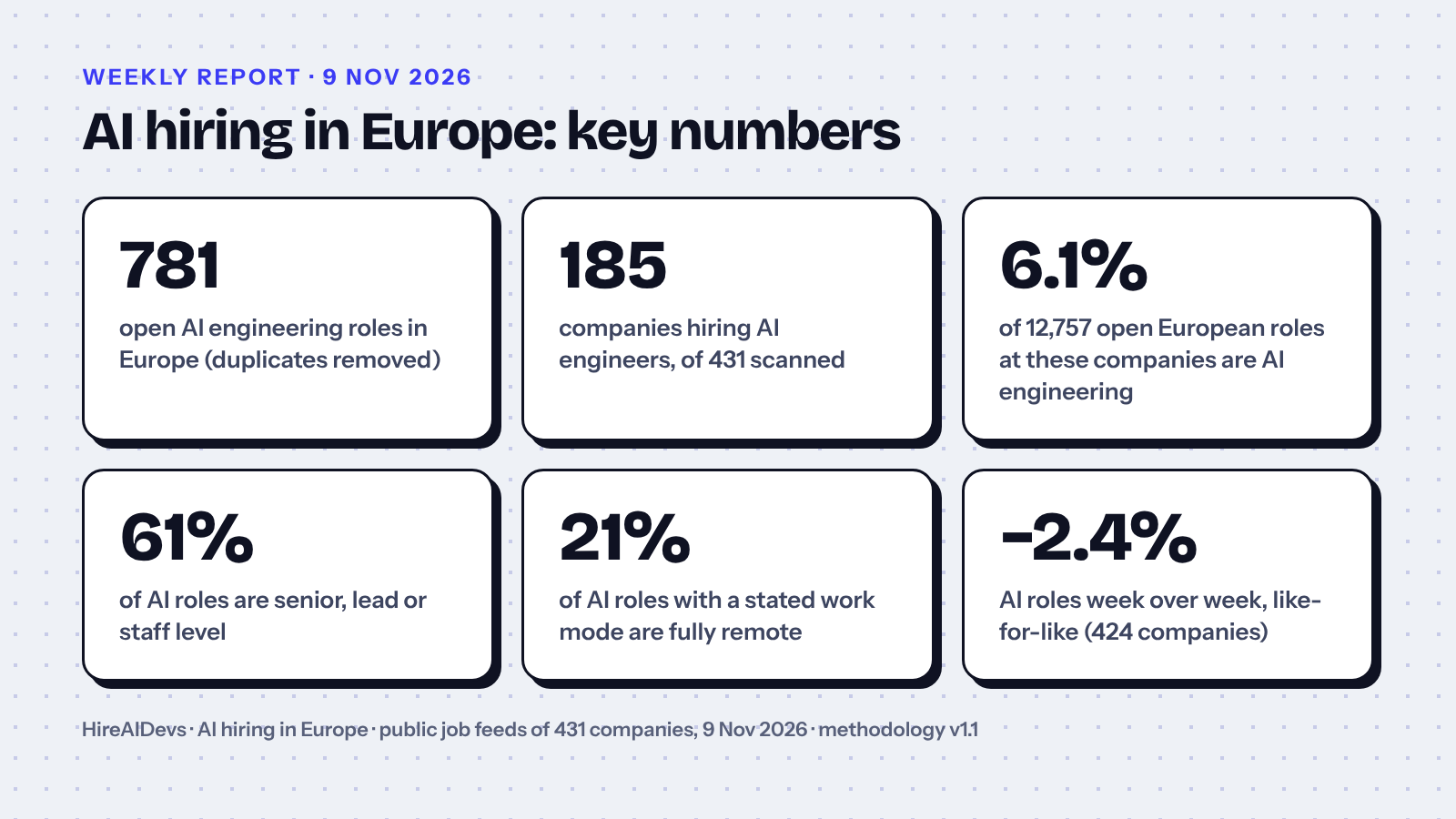
781 open AI engineering roles in Europe, at 185 of the 431 companies we scanned (identical adverts counted once).
Week over week, like-for-like: across the 424 companies whose feeds loaded in both weeks, AI roles fell from 800 to 781 (−19, −2.4%). Companies with at least one open AI role went from 186 to 185, and all open European roles at these companies went from 12,808 to 12,757.
Biggest increases: PhysicsX and Ocado Group (+2 each), Nebius, Lovable and ElevenLabs (+1 each). Biggest decreases: GetYourGuide (−5; its feed listed no open roles this week), Anthropic (−4) and Datadog (−3).
AI roles are 6.1% of the 12,757 open European roles at these companies. At AI-native companies the share is 11.6%; at large corporates it is 3.1%.
240 roles were published in the last 30 days, and 72 in the last 7 days.
61% of AI roles are senior, lead, staff or principal level. Only 3.5% are junior or internships. Across all roles at the same companies, 47% are senior or above.
Of the AI roles that state a work mode, 64% are hybrid, 21% fully remote and 15% on-site.
Only 5 of 781 roles (0.6%) are advertised as contract, freelance or fixed-term.
Hiring is spread widely: the three companies with the most open AI roles account for 11% of the total, so no single employer drives these figures.
Where the AI roles are
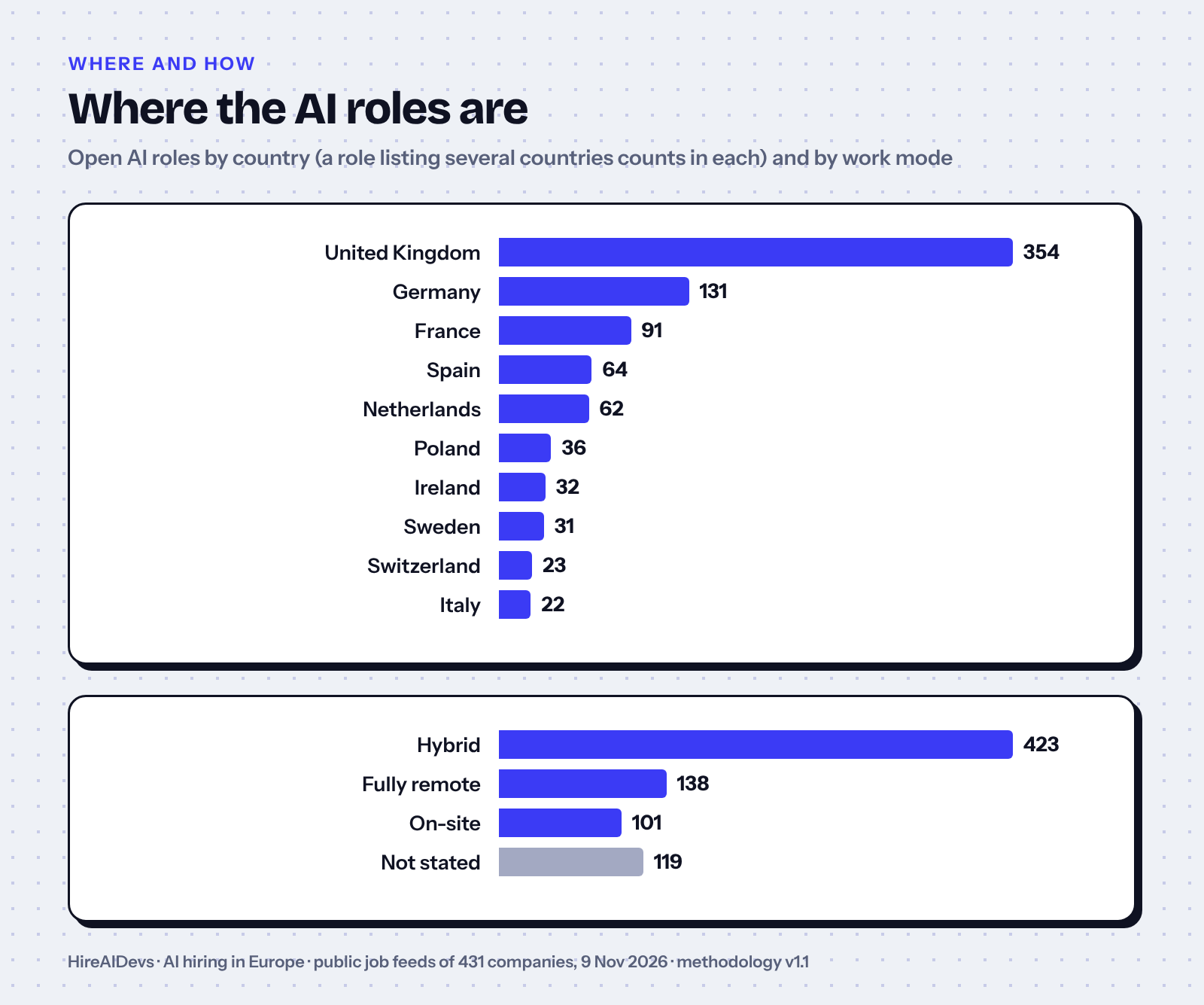
The UK leads with 354 roles, and London alone accounts for 290. Germany follows with 131 (Berlin 78, Munich 43), then France with 91 (Paris 78), Spain with 64 (Madrid 33) and the Netherlands with 62 (Amsterdam 49). A role listing several countries counts in each of them.
The AI share of hiring differs a lot by country. In the UK, 11.0% of open roles at these companies are AI roles, and in Switzerland 9.9%. In Germany it is only 4.6%: German companies are hiring heavily, but mostly for non-AI roles. Poland and the Netherlands both stand at 7.8%.
There are 138 fully remote AI roles, and European scale-ups offer most of them (90). Startups and AI-native companies are the most office-centric: 32 of their 93 AI roles are on-site.
What companies are hiring for
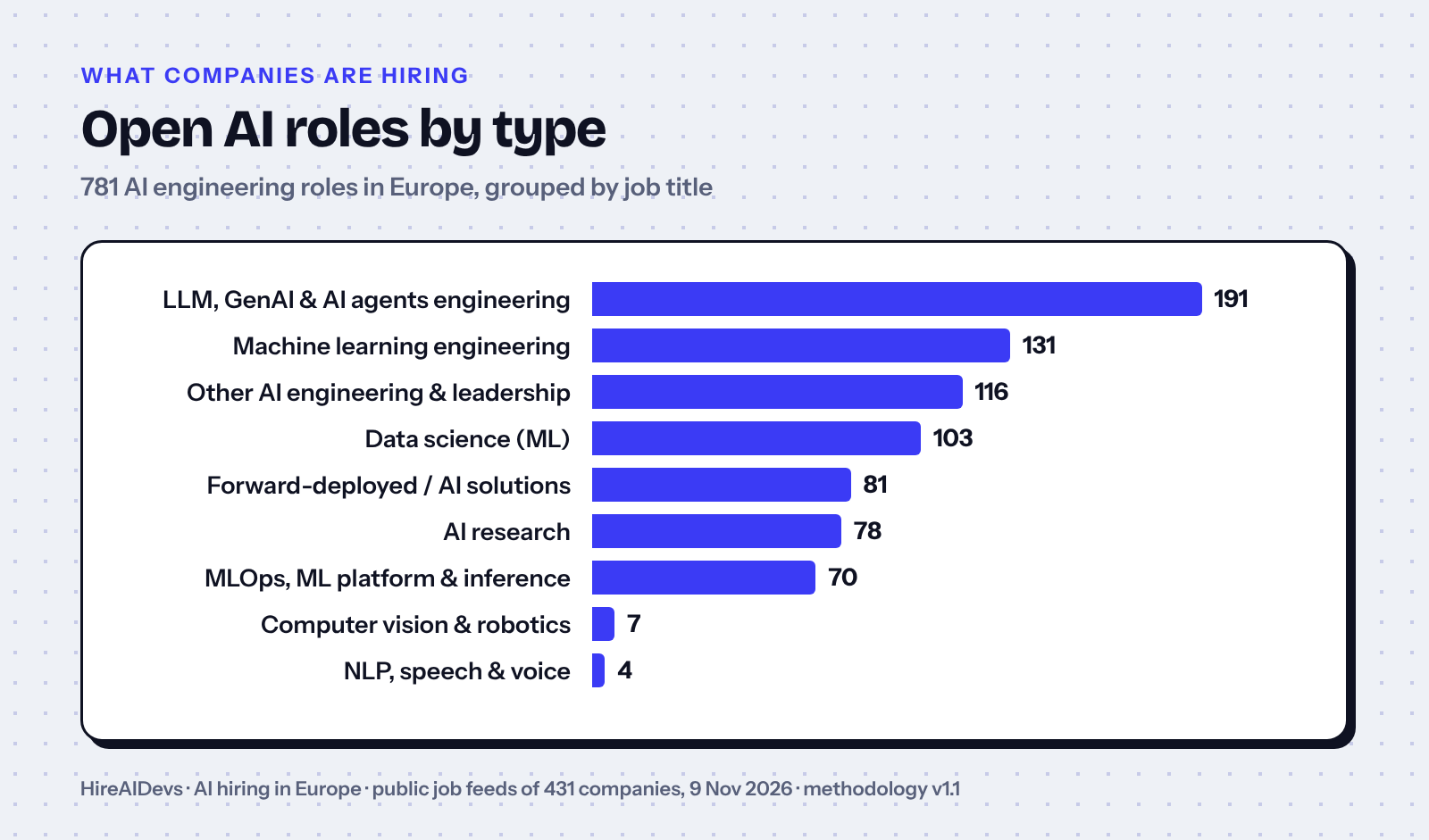
LLM, GenAI and AI agents engineering is the largest group with 191 roles. Titles include AI engineer, applied AI engineer, agent engineer and GenAI engineer.
Machine learning engineering (131) and ML data science (103) remain large, steady categories, and 116 roles sit in other AI engineering and leadership positions.
Forward-deployed and AI solutions engineers make up 81 roles, used mainly to put LLM agents into customers' production systems.
AI research has 78 roles, and MLOps, ML platform and inference has 70.
38 roles have "architect" in the title, for example AI architect or agent architect.
The companies with the most open AI roles in Europe this week are Nebius (31), OpenAI (30), Preply (26), Graphcore (24), Faculty and Anthropic (22 each), Prima and Databricks (19 each), Celonis (18) and Doctolib (17).
Skills in demand
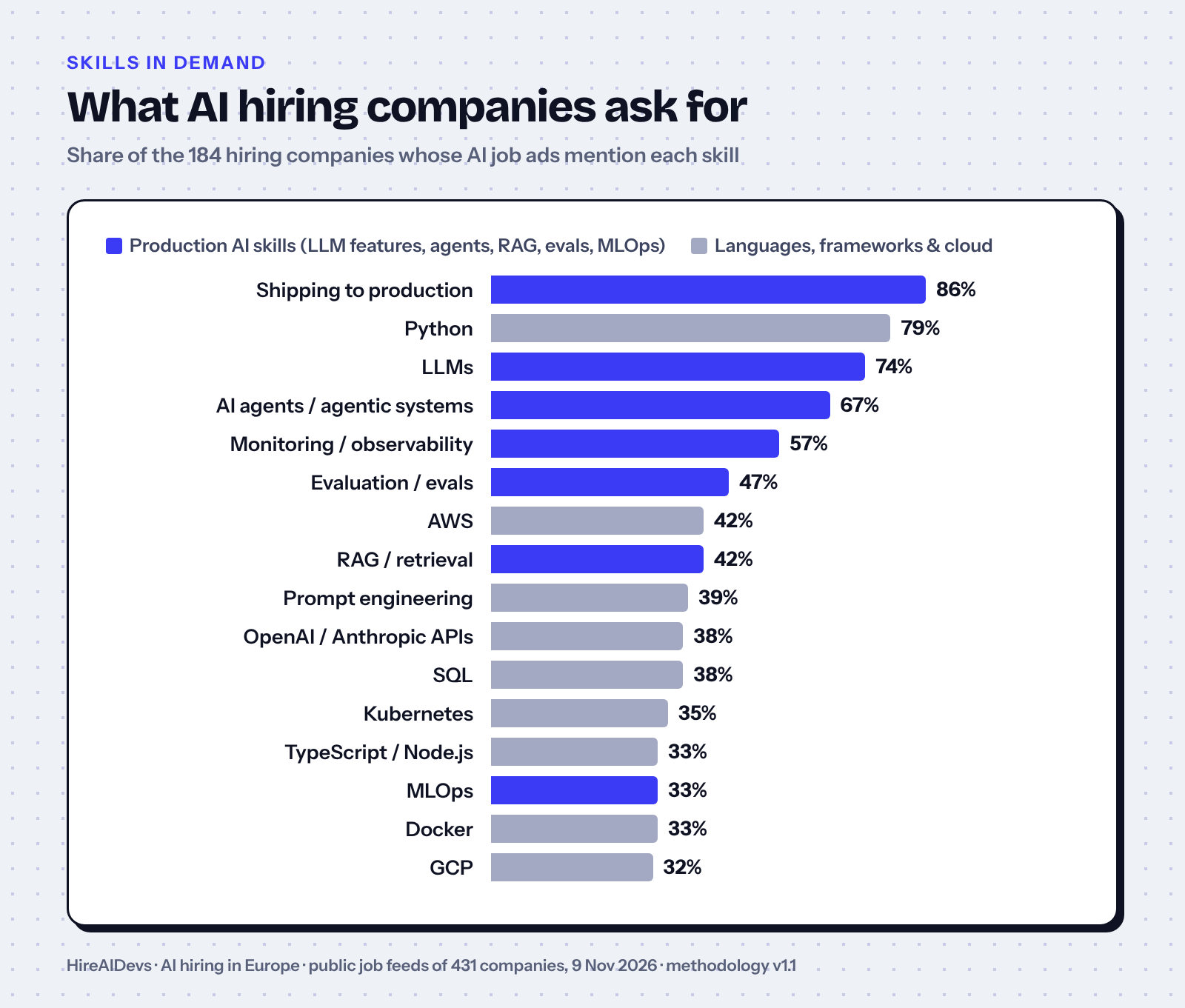
We counted skills both per job ad and per company. The company view is harder to distort: one employer posting many similar ads cannot move it. Of the 184 companies with AI job descriptions:
86% ask for experience shipping AI to production (74% of the 779 individual ads).
74% mention LLMs and 67% mention AI agents or agentic systems (49% of individual AI ads mention agents).
Monitoring and observability: 57%. Evaluation and evals: 47%. RAG and retrieval: 42%. Guardrails and safety: 30%.
MLOps: 33%. Fine-tuning: 24%.
Python: 79%. AWS: 42%. Kubernetes: 35%. PyTorch: 30%.
The takeaway is unchanged from last week: employers care less about specific tools than about the ability to build and run LLM systems reliably. These are the skills we test for when we vet our fractional AI engineers.
Salaries: what the job ads say
101 of the 781 AI roles, at 36 companies, publish a usable salary range in a European currency. We show the median advertised lower and upper bound for each group, converted to euros at ECB reference rates. Groups with fewer than 10 salaries, fewer than 3 companies, or one company providing more than half of the salaries are not shown.
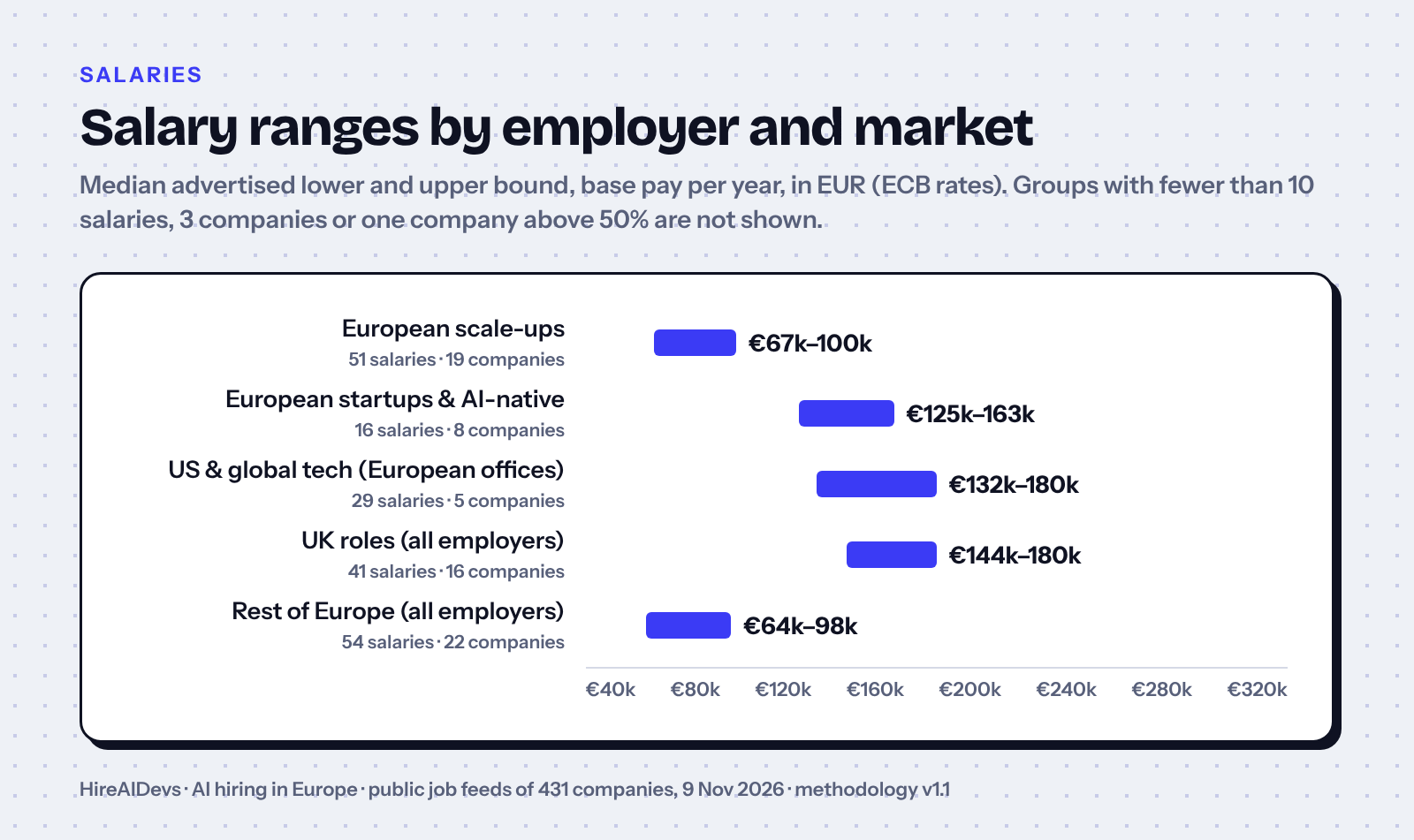
European scale-ups: €67k–100k (51 salaries).
European startups and AI-native companies: €125k–163k (16 salaries).
European offices of US and global tech companies: €132k–180k (29 salaries).
UK roles: €144k–180k, compared with €64k–98k for roles in the rest of Europe. France, the only single country outside the UK that passes our sample rules, comes in at €96k–130k (10 salaries).
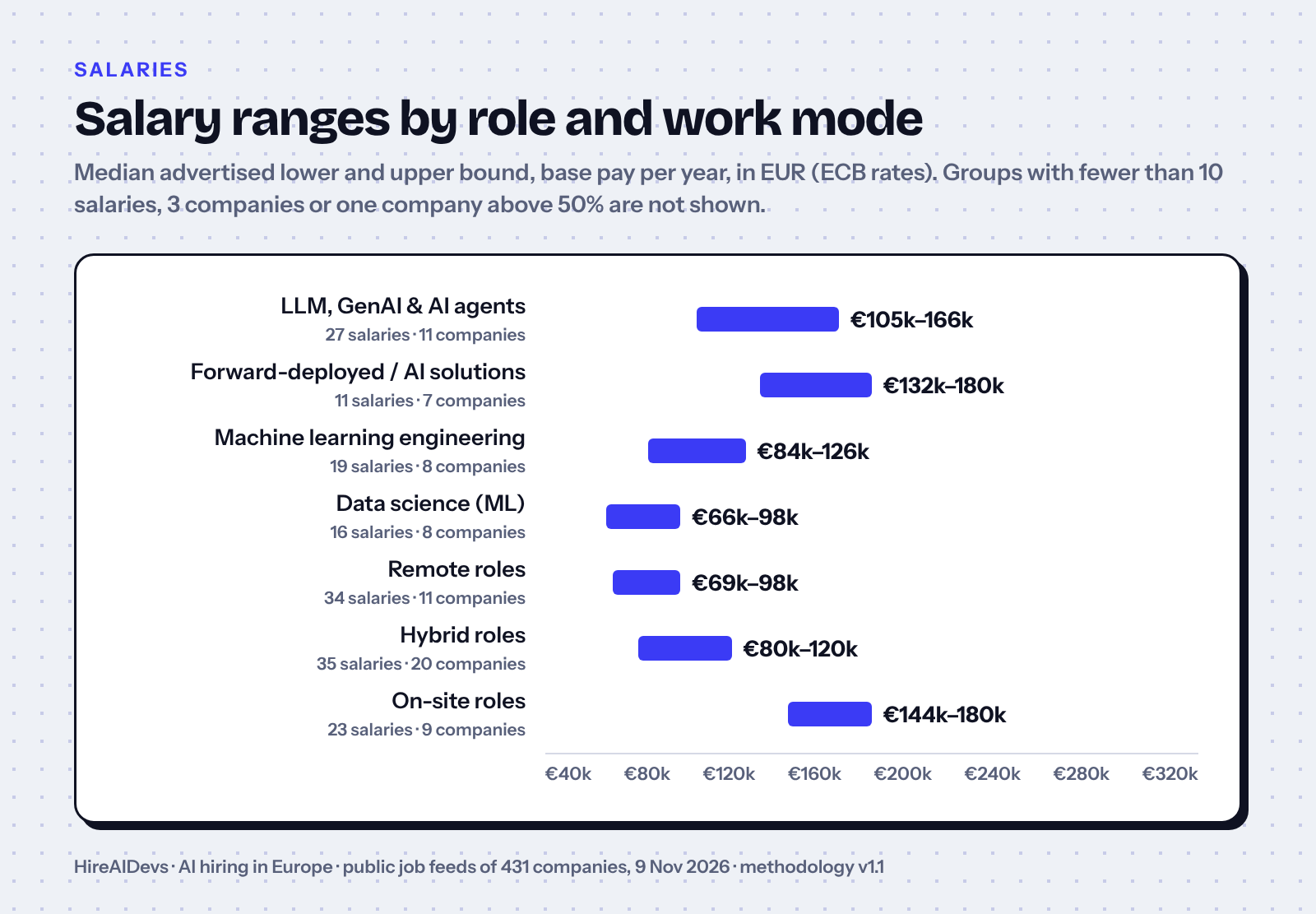
LLM, GenAI and AI agents roles: €105k–166k, above ML engineering (€84k–126k) and data science (€66k–98k). Other AI engineering and leadership roles: €65k–110k.
Forward-deployed and AI solutions roles: €132k–180k.
By work mode: remote €69k–98k, hybrid €80k–120k, on-site €144k–180k. The on-site premium mostly reflects London-based AI-native and US AI companies, which rarely hire remotely.
Not shown this week: AI research (9 salaries, one company provides more than half), MLOps (9 salaries), corporates (5 salaries), Germany, Spain, the Netherlands, Ireland and Poland (too few salaries or companies), and contract day rates (none published).
What this means for startups hiring AI engineers
Expect to compete for senior engineers. 61% of open AI roles are senior or above, and offices of US and global tech companies advertise €132k–180k. A full-time senior search can take months.
Screen for production skills, not frameworks. Ask candidates about LLM features they shipped, RAG, AI agents, evaluation and monitoring in production.
Flexible models are almost absent from the market. Only 0.6% of roles are contracts. A fractional AI engineer working 1–3 days a week can start in days, ship your first production AI features and help you define the full-time role.
Search across Europe. Advertised salaries outside the UK are roughly half of UK levels, and Europe-wide remote hiring widens both your talent pool and your budget options. For your first AI hire, see our guide to founding AI engineers.
Need senior AI capacity now? Book a 15-min call and meet vetted, Europe-based AI engineers.
Related guides
Methodology (version 1.1)
What this measures. Advertised AI engineering vacancies at a selected set of tech companies hiring in Europe: mostly startups, scale-ups and European offices of global tech companies. It is a snapshot of the companies covered, not of the whole European AI job market. HireAIDevs operates an AI engineering talent network; the data is collected and classified by fixed rules set in advance, described below.
Coverage. On 9 November 2026 we read the public job feeds (Ashby, Greenhouse, Lever, Workable, Recruitee, Personio and SmartRecruiters) of 431 companies. 424 feeds loaded, containing 26,743 advertised roles worldwide across all job categories. Of these, 12,757 were classified as European after removing 159 identical adverts. Feeds that failed to load this week: Learnworlds, Hugging Face, Clarity AI, Shield AI, Manual, Epignosis and Giskard. Week-over-week changes compare only the 424 companies whose feeds loaded in both weeks.
Europe. The EU/EEA, the UK, Switzerland, Ukraine, the Western Balkans and Moldova. Remote roles count when the advert's location names Europe, EMEA or a country in scope. A vacancy listing several countries counts once in the totals and once per country, so country figures can add up to more than the total. Identical adverts (same company, title and location) are counted once.
AI engineering roles. Identified from job titles using a fixed keyword list; non-engineering functions such as sales, recruiting, legal and marketing are excluded. This may miss AI-heavy roles with generic titles and include roles with limited AI focus.
Characteristics. Seniority comes from job titles; roles without a clear level are grouped as "mid or unspecified". Work mode and employment type come from job-board fields or advert text. Skills are counted when mentioned in a job description, which does not always mean the skill is required. Employer categories are HireAIDevs' approximate classification. "New" roles use the publication date reported by the job board.
Salaries. Published base-pay ranges only, annualised and converted to euros at the latest ECB reference rates available on the scan date (6 November 2026). Excluded: ranges in USD, duplicates and values outside €15k–€600k a year (or €150–€3,000 a day); this week 12 duplicates and 7 implausible values were removed. For each group we show the median lower bound, the median upper bound and the number of salaries. A group is shown only with at least 10 salaries from at least 3 companies, with no company contributing more than half. These are advertised ranges, not salaries actually paid.
Funding. Funding rounds come from cited third-party sources, not from job feeds. No section this week: we found no recent round we could verify for a company in our scan.
Limitations. Results depend on the selected companies and on feed availability; companies without public feeds, including many large corporates, are excluded. Vacancies are not hires. Title-based classification, incomplete adverts and undetected duplicates can affect results. All figures are approximate.
Corrections. Spot an error? Let us know through hireaidevs.io. Changes to this methodology will be listed here with their dates. Version 1.1, 5 November 2026: identical adverts removed from counts, minimum sample rules for salaries, ECB exchange rates and company-level skill figures added.
The next update will be published on Monday 16 November 2026.

Comments