
AI development agency vs fractional AI engineer: which does your startup need?
Updated: Nov 12
You've decided your product needs AI. Maybe it's a RAG assistant over your customers' documents, an AI agent that automates a workflow, or LLM features your competitors already ship. The next question is who builds it.
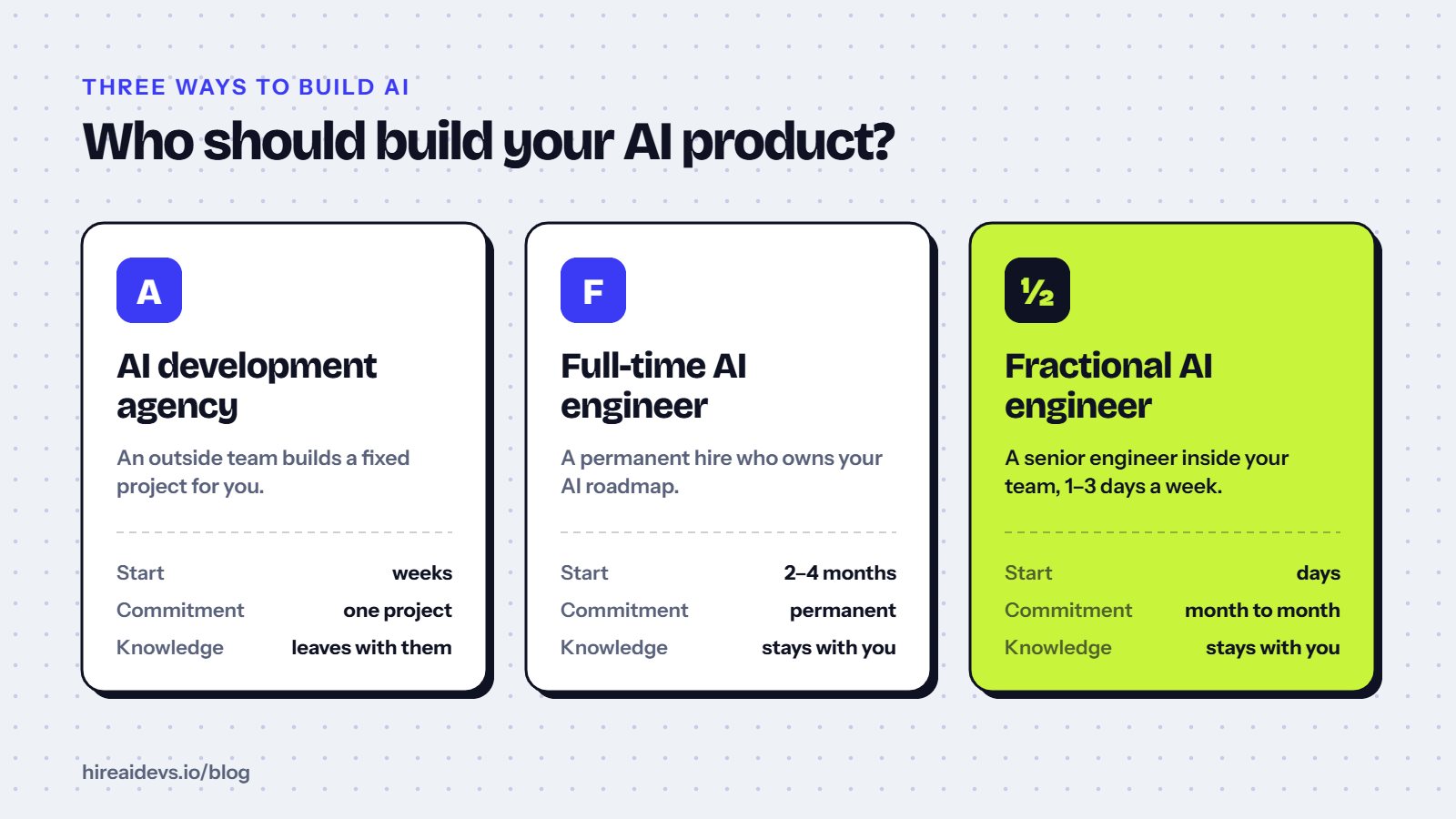
Most startup founders end up choosing between three options: hire an AI development agency, hire a full-time AI engineer, or bring in a fractional AI engineer for a few days a week. Each one fits a different situation. This guide explains the trade-offs so you can choose with confidence.
What an AI development agency does
An AI development agency (sometimes searched as "AI development services") takes a defined project and builds it for you with its own team. You agree on a scope, a timeline and a price, and the agency delivers.
Where agencies work well:
You need a one-off build with a clear, fixed specification.
You don't plan to keep developing the AI system after launch.
You want a single vendor to manage the whole project.
Where agencies struggle:
AI products rarely have a fixed spec. Models change, quality needs constant evaluation, and the first version is never the last.
Knowledge often leaves with the agency. When the project ends, your team inherits a system nobody inside the company fully understands.
You pay for the agency's overhead and margin on top of the people actually doing the work.
What a full-time AI engineer does
A full-time AI engineer joins your team permanently, owns your AI roadmap and builds knowledge inside the company.
Where a full-time hire works well:
AI is core to your product and you have a proven, ongoing roadmap.
You can afford a senior salary and equity, and you can wait for the right person.
Where it gets hard:
Senior AI engineers are scarce, and hiring one often takes months.
A wrong hire is expensive. Your first AI engineer shapes your architecture, and replacing them costs runway.
Many startups don't yet need 40 hours a week of senior AI work.
What a fractional AI engineer does
A fractional AI engineer is a senior AI engineer who works with your team part-time, usually 1–3 days a week, on an ongoing basis. Unlike an agency, they work inside your repositories, tools and stand-ups. Unlike a full-time hire, you can start in days and adjust the hours month to month.
Where a fractional AI engineer works well:
You're building your first AI features and need senior judgement on architecture, models and evaluation.
You have a prototype that works in demos but isn't reliable in production.
You're hiring full-time, and the roadmap can't wait for the search to finish.
What to watch out for:
A fractional engineer has limited hours, so priorities need to be clear.
They need to be genuinely senior. Part-time work only pays off when the engineer can make good decisions independently.
Side-by-side comparison
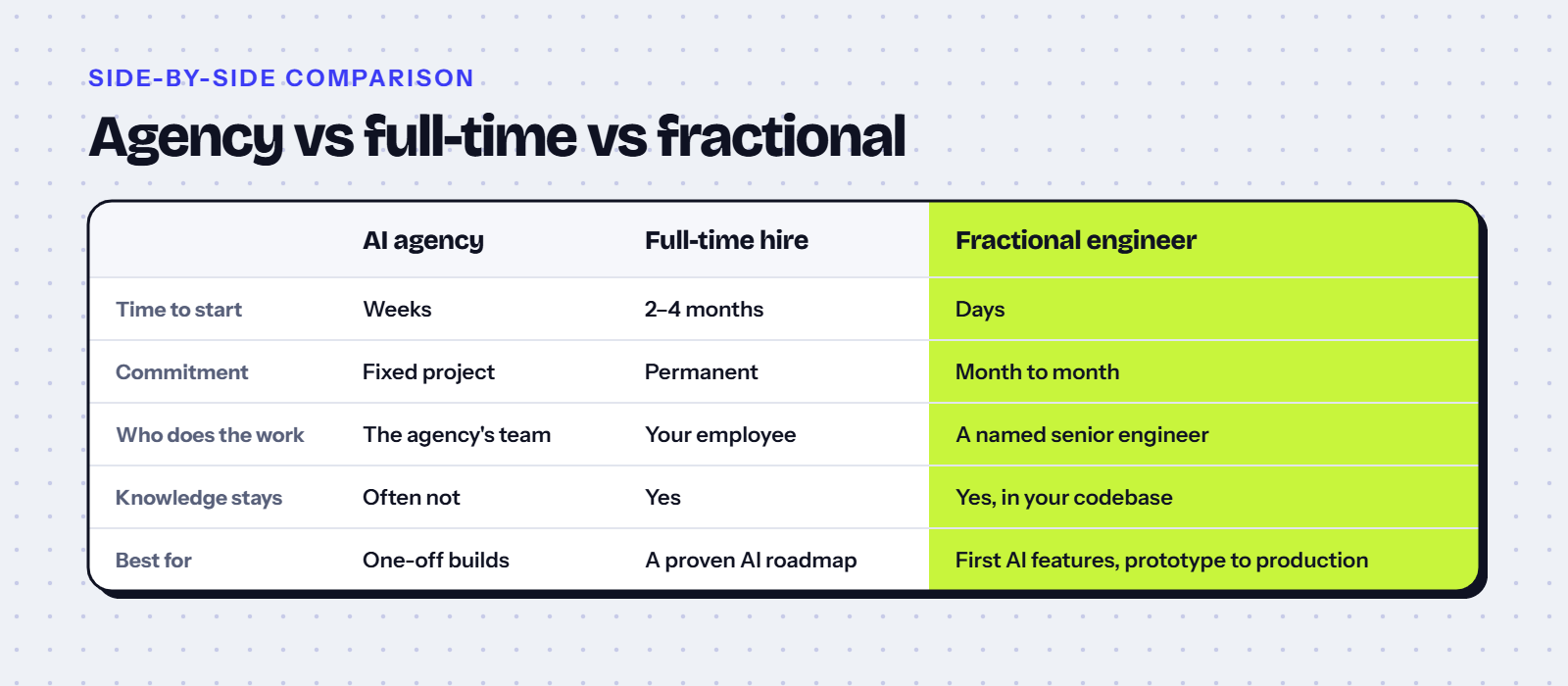
Time to start: agency in weeks · full-time hire in 2–4 months · fractional engineer in days.
Commitment: agency for a fixed project · full-time hire permanently · fractional engineer month to month.
Who owns the work: the agency's team · your employee · a named senior engineer inside your team.
Knowledge stays with you: often not with an agency · yes with a full-time hire · yes with a fractional engineer, because they work in your codebase.
Best for: agency for a one-off build · full-time hire for a proven AI roadmap · fractional engineer for first AI features, getting a prototype to production, or bridging until a full-time hire.
Five questions to help you decide
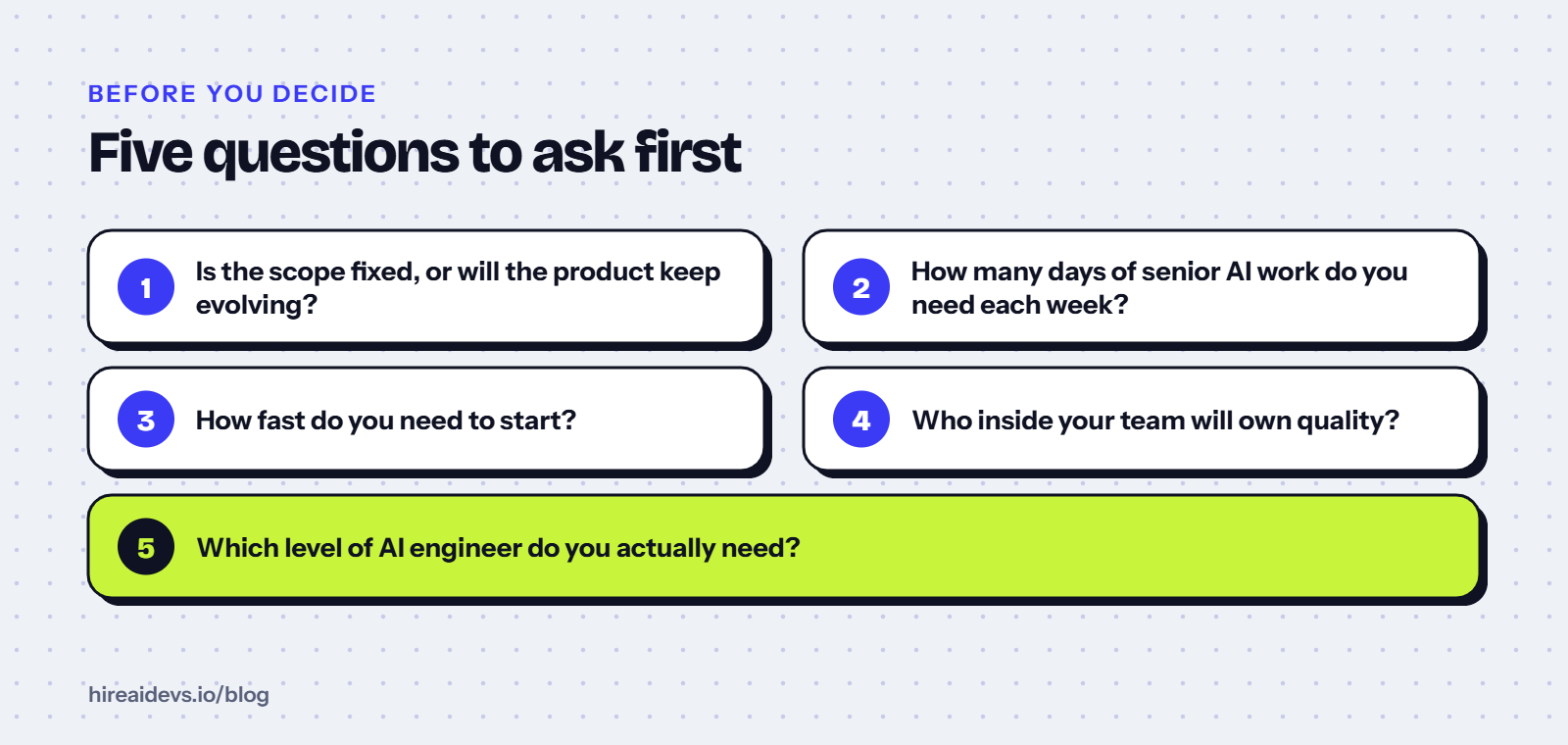
Is the scope fixed? If yes, and you won't maintain it, an agency can work. If the product will keep evolving, you need someone inside the team.
How much senior AI work do you need each week? One to three days points to fractional. A full roadmap points to full-time.
How fast do you need to start? Fractional engineers can usually start within days. Full-time hiring takes months.
Who will own quality? Someone needs to own evaluation, monitoring and the decisions behind the architecture. That person should sit inside your team.
Do you know which level of AI engineer you need? Building LLM features, owning a production RAG system and training custom models are different jobs. Our AI engineer levels guide explains the difference.
A common path for startups
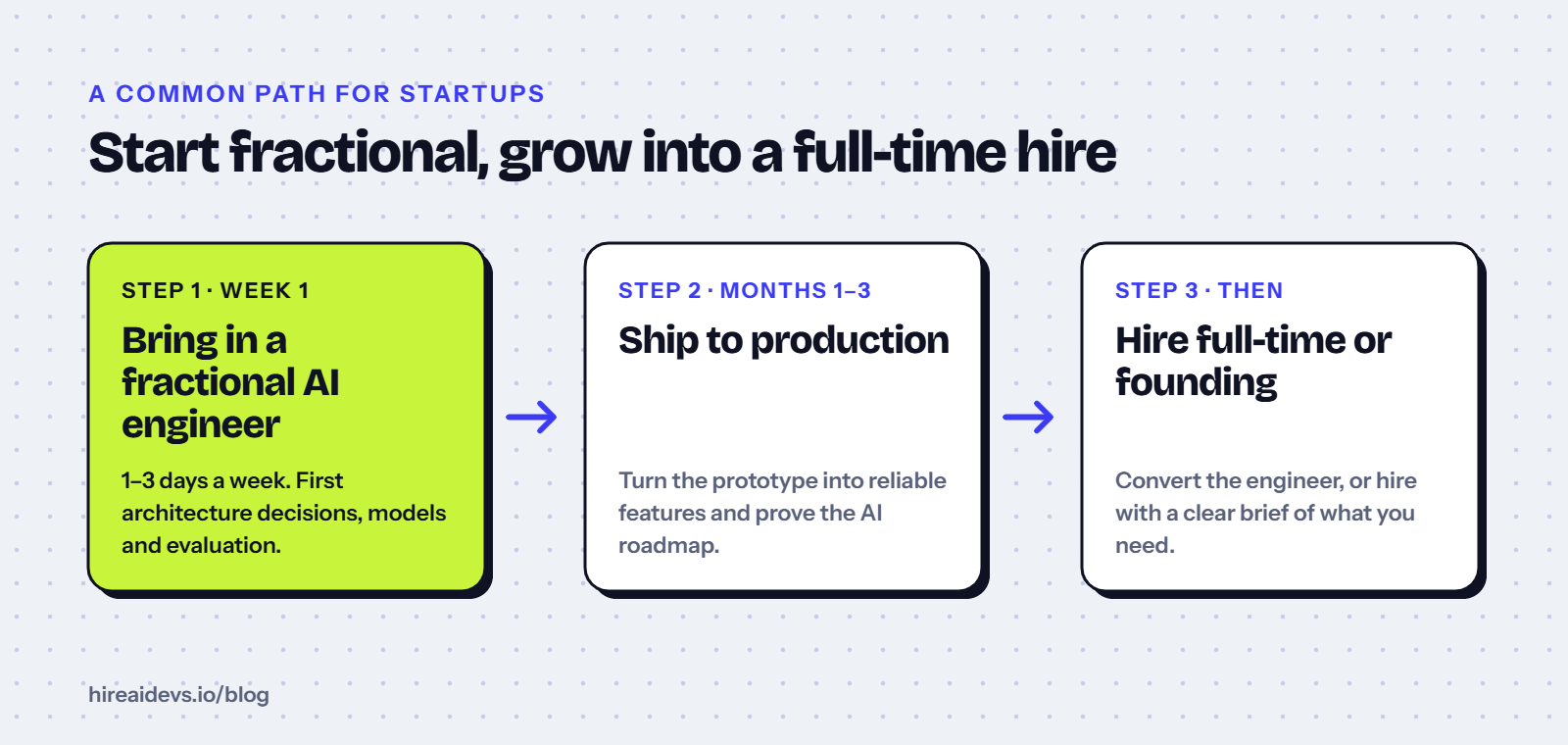
Many startups combine the options over time. They start with a fractional AI engineer to make the first architecture decisions and ship the first production features. Once the roadmap is proven, they convert that engineer into a full-time or founding AI engineer, or use what they've learned to hire the right person.
This approach keeps knowledge in the company from day one and avoids the most expensive mistake: a rushed senior hire, or an agency-built system nobody can maintain.
Related guides
Need help choosing?
HireAIDevs connects startups with vetted, Europe-based AI engineers for fractional and founding roles. Tell us what you're building and we'll suggest the right level and introduce 2–3 engineers within 48 hours. Book a 15-minute call.

Comments